Friday, January 21, 2011

Re: How sustainable are biofuel crops?

A recent article by a group of German researchers in Global Change Biology-Bioenergy

(http://onlinelibrary.wiley.com/doi/10.1111/j.1757-1707.2010.01088.x/pdf)

looks at the future of biofuel crop expansion with respect to environmental concerns as well as agricultural constraints.

One of their main points is that, not surprisingly, devoting more of our ever-precious land for new (albeit promising) uses is not straightforward. There are already major land constraints globally (see figure above) where it is recognized that we should not devote further land for new uses. These reasons are colored in the figure above: the land is already protected, it is part of a sensitive wetland, it includes designated wilderness or has been identified as has having high biodiversity, carbon losses on conversion of the land would not be regained within a period of 10 years (LUC emissions), or these areas are already agricultural lands deemed necessary for food production.

While the authors estimate that bioenergy crops can account for a substantial amount (15-25%) of world energy demand by 2050, there are potential caveats, such as putting pressure on delicate ecosystems and fragmenting land. All of these issues are likely to have negative effects on biodiversity and threatened and endangered species.

My take-home message from reading this article:
It is imperative to be thinking long-term and focusing on renewable energy technology, yet we should definitely keep in mind the long-term and short-term sustainability of how biofuels affect our precious land.

Monday, January 10, 2011

Re: BiofuelsWatch

I stumbled upon an interesting blog with lots of info on biofuels, renewable energy, and climate change, in general.

http://www.biofuelswatch.com/

Though brief and not very technical, there is a nice overview on how biofuels (both ethanol & biodiesel) are made:

http://www.biofuelswatch.com/how-are-biofuels-made/

Also, a blurb on what is biofuel energy?

http://www.biofuelswatch.com/what-is-biofuel-energy/

And I particularly liked this one (though it is hardly thorough) on the good & bad of biofuels:

http://www.biofuelswatch.com/are-biofuels-good-or-bad/

Wednesday, December 15, 2010

Re: great editorial on plant research...or lack of

I just came across this article in Science that points out how so little of our public research dollars go towards basic plant (agricultural) research. They claim that 2% of federal spending on research R&D goes to agricultural research. I am reminded of the general public bias out there which I noticed beginning as a graduate student when I decided to work on plants rather than animals or fungi or microbes. I've also been told by several faculty that their postdocs do quite well in a plant-specific search, but usually lose out to equivalent job candidates who study animals. Once I gave a talk and one of the faculty members afterwards mentioned that hearing my talk was the first time he actually found anything having to do with plants interesting. I was obviously flattered, but also appalled that so many people are so uninterested in plants.

Hey! Where does your food come from?? Ultimately, the answer is almost always plants. Who gobbles up CO2 and spits out oxygen for us to breathe?? Uh, plants. Does anyone wear cotton or linen anymore? They also come from plants. And your house is also likely made with wood (plants). Yep, plants make it possible for us to survive and thrive.

I know we are pretty animal focused (being animals ourselves), but I hope we can develop a better appreciation and understanding of plants. I know everyone wants a cure for cancer, but I would argue that funding basic research in plant biology is also crucial for our survival and health.

A new focus on Plant Science by McCormick & Tijian
Science 19 November 2010: Vol. 330 no. 6007 p. 1021
DOI: 10.1126/science.1198153

http://www.sciencemag.org/content/330/6007/1021.full.pdf

Thursday, December 9, 2010

Re: biofuel crops as habitat?

Just ran across this article in a new pub, Global Change Biology (GBC) Bioenergy which looked at how perennial feedstocks impact animal biodiversity. Perennial biomass feedstocks enhance avian diversity by Robertson et al. 2010 (DOI: 10.1111/j.1757-1707.2010.01080.x). [Note: sorry I will try to find "open" articles, but this is tough!! Please let me know if you want me to send pdf]

The authors looked at bird (and bird food=bugs) diversity and abundance in 3 kinds of habitat:
1) corn monoculture
2) switchgrass plot
3) mixed-grass prairie

This included surveying 20 sites of each type above, but just in the upper mid-west (Michigan).

The clear expectation is that corn (annual plant) would support the lowest bird diversity (this has already been shown). We also already know that mixed-grass prairie, which is largely what the midwest once was before modern agriculture, supports very high bird diversity and abundance. The big question is, what would the perennial switchgrass plot (switchgrass is native to N. America and is one of the mixed prairie grasses) be like in terms of supporting bird diversity and habitat?

It turns out that there was a greater diversity of birds with a larger patch (plot) size for both switchgrass & prairie, but not for corn. Also, the perennials (not corn) supported more arthropods (mainly insects), a key component in many birds' diets. Even though there was greater bird diversity overall in the mixed prairie habitat, the switchgrass plot was also pretty good.

Overall, this suggests that at least for some locations and for one species of cellulosic feedstock (switchgrass)--growing perennial energy crops can be managed to maintain habitat for native grassland birds.


Monday, November 29, 2010

snapshot of the cellulosic energy grasses

Whenever I mention what I work on, nobody has ever heard of Miscanthus. Of course I consider my friends, family, & acquaintances to be pretty well-informed smart people, so this seemed a bit surprising. This lack of awareness about the incredible potential of Miscanthus & other crops as biofuel crops has been a big reason why I started this blog.

In order to simplify and clarify, I decided to make a brief list & descriptor (in no particular order) of the major energy crops, focusing on the perennial grasses. There are also non-grass cellulosic energy crops (such as poplar, willow, Jatropha and Agave--see previous blog post), which I will not go into here. Disclaimer: this is hardly an exhaustive description of all of these grasses, just what I choose to include...

1) Miscanthus (known sometimes as Elephant grass or Amur silver grass, this includes mainly the sterile hybrid Miscanthus x giganteus, but also relatives such as M. sinensis, M. sacchariflorus, M. floridulus). Tropical to temperate. Native to Asia & Africa.
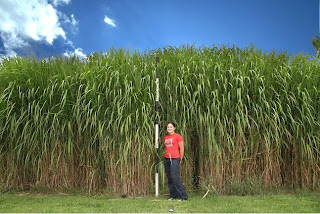

Advantages: No fertilizer (nitrogen) input required, low degree of invasiveness (hybrid M. x giganteus is sterile), cold-tolerant, highly productive (see photo above!!), a carbon neutral source of fuel when life-cycle is considered, lots of natural variation in M. sinensis & M. sacchariflorus, can grow on marginal lands
Disadvantages: high initial planting costs (must plant rhizomes rather than seeds, due to sterility), M.x giganteus plants typically grown are all cuttings from a single genetic clone (greater genetic variation is typically favored), fairly high water needs during growing season--limits use in arid western U.S.

2) Switchgrass (commonly known as panic grass, Panicum virgatum) Native to North America.
Advantages: cold-tolerant, fairly drought-tolerant, relatively low fertilizer inputs needed, a carbon neutral source of fuel when life-cycle is considered, highly diverse, can grow on marginal lands
Disadvantages: roughly half as productive as Miscanthus in most climates, relatively high water needs during warm growing season (spring/summer) which limits use in much of the western U.S.

3) Maize (corn). Native to North America. Annual rather than perennial.
Advantages: well-established as an ethanol crop when using seeds, annual crops have some benefits, can use the stover (leaf tissue) as a byproduct of seed production for cellulosic ethanol production
Disadvantages: very high fertilizer and water input needs--leading to high carbon costs, not as prolific as dedicated cellulosic perennial grasses, growth for ethanol production competes with growth for food

4) Sugarcane (many species of Sachharum) Tropical to warm temperate climates, Native to South Asia. Brazil is the largest grower of sugarcane, where they generate ethanol as a by-product of sugar production. Brazil is self-sufficient in terms of fuel production due to this investment in sugarcane-based ethanol.
Advantages: high sugar content--sugar is directly fermented into ethanol,
Disadvantages: very water intensive, grows in tropical (warm) climates only thereby limiting its growth in the primarily temperate U.S., not typically grown for cellulosic biofuel production

5) Energy cane (sugarcane hybrids produced to make low sugar varieties).
Advantages: hybrids (crop behind person in above photo) often have increased vigour and are highly prolific, the energy cane varieties are bred to be more cold-tolerant than sugarcane which increases the growing range in the U.S., can potentially convert to ethanol in the same way as other cellulosic biofuel crops, can be more productive than sugarcane (producing more ethanol per unit of land)
Disadvantages: unless a "no sugar" variety is developed, separate conversions to ethanol are necessary (e.g., different process to convert sugar to ethanol vs. converting cellulose to ethanol), relatively high water needs, initial planting costs are high/intensive (established from cuttings rather than seeds), not cold-tolerant

6) Sweet sorghum (many varieties of Sorghum with high sugar content). Native to tropical and sub-tropical regions on all continents (except Antarctica)
Advantages: fairly high yield, relatively drought tolerant, direct conversion to ethanol from sugar (not typically cellulose)
Disadvantages: grown primarily for sugar conversion directly to ethanol rather than as a cellulosic form of ethanol production...but could be used for both (like energy cane), annual rather than perennial, high fertilizer needs, susceptible to pests, not cold tolerant


7) Native prairie (many species, primarily Switchgrass [Panicum virgatum], Indiangrass [Sorghastrum nutans], Eastern Gamagrass (Tripsacum dactyloides), Big Bluestem (Andropogon gerardii), Little Bluestem (Schizachyrium scoparium), and others)
Advantages: high biodiversity, excellent habitat for wildlife, renewable, requires no fertilizer or irrigation
Disadvantages: generates only a fraction of the productivity compared with dedicated energy crops

Thursday, November 11, 2010

life-cycle analysis of greenhouse gas emissions

We already know that most of our energy comes from fossil fuels AND fossil fuels spew tons of greenhouse gases (GHG) that contribute to global warming, but are biofuels actually much better?? The answer is...it depends.

Energy analysts and economists are now looking at the entire life-cycle of producing fuels (which includes extraction of fuel, or planting to processing, transport, and the burning of fuels as emissions). Gasoline is usually used as the reference, and ideally, other forms of fuels emit LESS greenhouse gases than gasoline when the entire life cycle is taken into account.

In this 2009 life-cycle analysis of different types of fuels (http://www.pnas.org/content/106/6/2077.full), Hill et al. found that corn based ethanol produced as much or even more greenhouse gas emissions (including CO2, N2O, and CH4), than gasoline, a surprising result at first. But the GHG emissions differed in production of corn ethanol depending on the source of heat at the biorefinery (whether it was fueled by natural gas, coal, or corn stover--the left-over "leaf" part of a corn plant after the fruits are harvested).

As a bright point, cellulosic ethanol has significantly reduced levels of GHG emissions relative to either corn ethanol or gasoline, when the life-cycle of the fuel production is accounted for. Of note, however, is that the data used to estimate emissions for cellulosic biofuels is relatively limited as this form of ethanol production has not been done to scale.

Costs of GHG (A) and particulate matter: PM2.5 (B) emissions. Per liter and per gallon estimates are shown alongside total costs arising from production of an additional billion gallons of ethanol or an energy-equivalent volume of gasoline. (C) Combined costs of GHG and PM2.5. From PNAS article by Hill et al. 2009. http://www.pnas.org/content/106/6/2077.full


Why is corn-based ethanol not an improvement over gasoline with respect to fossil fuel emissions? The answer is that corn is a fairly intensive crop, it needs a lot of nitrogen fertilizers , and has higher fossil fuel input, all of which contribute to increased GHG emissions. Cellulosic ethanol production is better, when the life-cycle is accounted for, because it requires little to no fertilizer and lignin combustion from the cellulosic crops provides excess heat and power at the biorefinery, which displaces fossil fuel and electricity consumption.

While cellulosic biofuels are a large improvement over conventional forms of corn-ethanol and gasoline in terms of GHG emissions, there is rarely such thing as a golden ticket. That is, there are trade-offs to GHG reductions in terms of other forms of air pollution. From studies (http://dancingflames.org/dancingflames/EnvSci/Articles/EnvScipdffiles/EthanolPublicHealth.pdf, http://www.afdc.energy.gov/afdc/pdfs/technical_paper_feb09.pdf) looking at E85 blend fuels (85% ethanol blended with 15% gasoline) compared to straight gasoline, emissions are reduced for several greenhouse gases, but emissions INCREASE for other pollutants (such as ethanol, formaldehyde, and acetaldehyde). Both formaldehyde and acetaldehyde are nasty carcinogens, as classified by the U.S. EPA. Unburned ethanol can also oxidize to acetaledehyde, so these air pollutants (while not classified as greenhouse gases) have potential human health risks.

Like most things, there is no simple single solution. And it would be good to see ways to reduce both GHG emissions AND other forms of air pollution if we want to move forward with renewable fuel sources. Sorry, but the grass is not always cleaner.

Monday, November 1, 2010

Carbon-free energy

Globally, 87% of our energy comes from fossil fuels. These are dense sources of energy (see previous post on why oil tastes so good) & oil transports and stores well...but what about greenhouse gas emissions? Reams of evidence have demonstrated that greenhouse gases, such as CO2 (carbon dioxide), in excess, contribute to the overall warming of our planet. And fossil fuels produce A LOT of CO2. Another problem with fossil fuels is that they are a finite resource. Some estimates say that only ~100 years of oil resources remain (Source: World Energy Assessment 2000 & 2004/UNDP ). http://www.undp.org/energy/activities/wea/drafts-frame.html

Renewable energy sources (such as solar, wind, biomass, and geothermal), on the other hand, have very low CO2 output per kilowatt-hour of energy produced (See figure at http://www.sciencemag.org/cgi/reprint/329/5993/786.pdf). But given the amount of energy we currently use, is there enough renewable energy to meet this demand? The single largest potential comes from solar energy, where the total amount of solar energy available on earth's surface is several orders of magnitude greater than what we currently use, as a planet. And there is a good chance we could capture enough of that to generate the amount of power the world now consumes. One of the current challenges with solar, however, is energy storage. Sunlight does not shine in one solar panel 24/7, and we need more inexpensive, more efficient ways to store this energy when it is not being generated. There are many great leads to building better batteries out there..but I am not an engineer and will pass on further comment for now.

Biomass can be thought of as another source of solar energy, as plants convert sunlight into energy that is stored in the plant as sugar (via photosynthesis). Even though plant growth is seasonal, with an abundance of plant material (feedstock) at the end of the summer growing season, the leaves can be harvested and stored until energy is needed. A disadvantage of biomass, however, is that is requires resources such as water and land.

While there is much promise in renewables replacing fossil fuels, most experts agree that the best future outcome will include a number of different renewable energy sources and technologies.